
AI language models have a genuine, well-documented limitation: they can only draw on information from their training data, which means they cannot naturally access current events, private company documents, or any information that did not exist when they were trained. Retrieval-augmented generation, commonly abbreviated as RAG, addresses this limitation directly, and understanding how it actually works reveals a genuinely clever technical approach used across many modern AI applications.
What RAG Actually Means
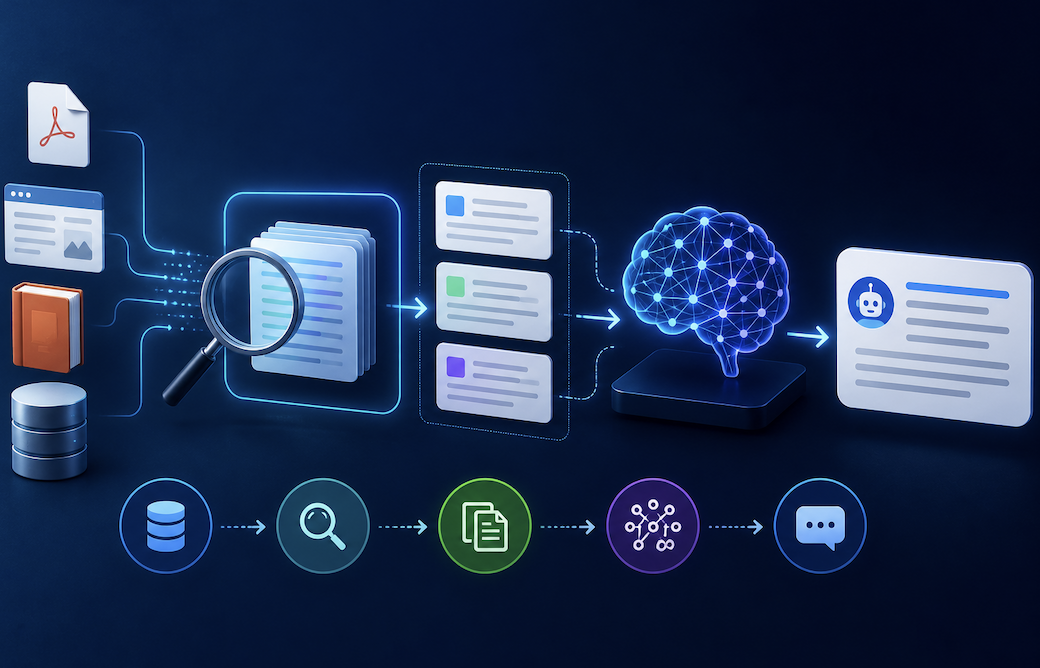
Retrieval-augmented generation refers to a technique that combines an AI language model with an external information retrieval system, allowing the model to search for and incorporate relevant, current information before actually generating a response. Rather than relying purely on patterns learned during training, a RAG system first retrieves relevant documents or data, then uses this retrieved information to inform and ground its generated response.
This combination genuinely addresses one of the most significant practical limitations of standalone language models, since it allows the AI system to access information considerably more current, specific, or private than anything included in its original training data, without needing to retrain the entire underlying model.
How RAG Actually Works Step by Step
Understanding the genuine technical process behind RAG helps clarify exactly how this technique combines retrieval and generation to produce more accurate, grounded responses.
- A user submits a query or request to the AI system
- The system searches a designated knowledge base or document collection for genuinely relevant information
- This retrieved information gets provided to the language model alongside the original query
- The language model then generates a response, informed by both its training and this newly retrieved information
This retrieval step genuinely matters because it means the language model does not need to have memorized specific facts during training, but instead can reference actual, current source material when generating its response, considerably improving accuracy for information that extends beyond or updates what the model originally learned.
Why RAG Genuinely Reduces AI Hallucinations
Understanding why this technique specifically helps address the genuine problem of AI systems confidently generating inaccurate information reveals one of RAG’s most valuable practical benefits.
- Standalone language models generate responses based purely on learned statistical patterns, without fact verification
- RAG grounds responses in actual retrieved source documents, providing genuine factual backing
- This grounding significantly reduces the likelihood of confidently generated but entirely fabricated information
- Responses can often include citations to the specific source material actually used, improving genuine verifiability
This citation capability deserves particular emphasis, since it allows users to actually verify the specific source behind a RAG system’s response, providing a genuinely important layer of accountability and verification that standalone language models typically cannot offer, given they generate responses without referencing any specific, identifiable source material.
Common Business Applications Where RAG Provides Genuine Value
Understanding the practical business contexts where RAG has become genuinely valuable helps illustrate why this technique has seen such widespread adoption across various AI applications.
- Customer support systems that need to reference a company’s genuinely current product documentation
- Internal knowledge management tools that help employees search across genuinely private company documents
- Research applications that need access to recent publications beyond a model’s original training cutoff
- Legal and compliance applications requiring responses grounded in specific, genuinely verifiable source documents
Why RAG Represents a More Practical Alternative to Constant Retraining
Understanding why RAG has become genuinely preferred over the alternative approach of continuously retraining language models with updated information helps explain its practical appeal for many organizations.
- Retraining large language models requires substantial computational resources and considerable time
- RAG allows updating the accessible information simply by updating the retrieval system’s document collection
- This makes keeping an AI system current with new information considerably more practical and cost-effective
- Organizations can maintain private, proprietary information within their retrieval system without needing to train it directly into the model
This practicality advantage deserves genuine emphasis, since organizations using RAG can update their knowledge base simply by adding, removing, or modifying documents within their retrieval system, a considerably simpler and faster process compared to the substantial computational undertaking that retraining an entire language model would actually require.
The Genuine Technical Components That Make RAG Work
Understanding the underlying technical infrastructure that makes RAG systems function helps provide additional insight into how this approach actually operates beneath the surface.
- A document collection or knowledge base containing the information the system should be able to reference
- A retrieval mechanism that can efficiently search this collection to find genuinely relevant information
- The language model itself, which generates the final response incorporating retrieved information
- A process for combining the retrieved information with the original query before generation actually occurs
Practical Considerations for Understanding RAG-Powered Tools
- Understand that RAG-powered responses are only as accurate as the underlying document collection being searched
- Outdated or inaccurate source documents can still lead to genuinely inaccurate responses despite the RAG approach
- Citations provided by RAG systems offer a valuable way to verify information rather than trusting responses blindly
- Not every AI tool uses RAG, meaning understanding whether a specific tool employs this technique matters for evaluating its outputs
How RAG Handles Conflicting or Ambiguous Retrieved Information
Understanding how a genuinely well-designed RAG system handles situations where retrieved documents contain conflicting or ambiguous information provides additional insight into the real-world complexity involved in implementing this technique effectively.
When a retrieval system surfaces multiple documents that genuinely disagree on a specific point, or when the retrieved information only partially addresses the original query, the language model still needs to synthesize a coherent response from this potentially imperfect input. This is precisely why the quality of both the retrieval
mechanism and the underlying language model’s synthesis capability genuinely matter together, since even excellent retrieval cannot fully compensate for a language model that struggles to appropriately handle nuance, acknowledge uncertainty, or clearly indicate when retrieved sources genuinely disagree with each other.
- Retrieved documents can sometimes contain genuinely conflicting or incomplete information
- Well-designed RAG systems need to handle this ambiguity thoughtfully rather than presenting false confidence
- Both retrieval quality and the language model’s synthesis capability matter together for reliable results
- Understanding this complexity helps set realistic expectations for RAG system reliability in practice
Final Thoughts
Retrieval-augmented generation addresses a genuinely significant limitation of standalone AI language models by combining them with an external retrieval system, allowing access to current, specific, or private information beyond what was included in original training data. Understanding how this technique actually works, and why it genuinely reduces hallucination risk while enabling source verification, provides valuable insight into how many modern, practical AI applications achieve considerably greater accuracy and reliability than would otherwise be possible.
Frequently Asked Questions
1. Does RAG completely eliminate AI hallucinations?
No, while RAG significantly reduces hallucination risk by grounding responses in actual retrieved documents, it does not eliminate this issue entirely, since the model can still occasionally misinterpret or inaccurately synthesize the retrieved information during generation.
2. How is RAG different from simply searching the internet and summarizing results?
While conceptually related, RAG typically involves a more structured, integrated process where retrieval and generation work together within a single system, often searching a specifically curated document collection rather than the broader open internet, though some RAG implementations do incorporate web search specifically.
3. Can RAG be used with any AI language model?
Generally yes, since RAG represents an architectural approach that can be combined with various underlying language models, making it a genuinely flexible technique rather than being tied to one specific model or provider.
4. Is RAG only relevant for large businesses with extensive document collections?
No, RAG can genuinely benefit organizations and individuals of various sizes, since even a modest collection of relevant, current documents can meaningfully improve an AI system’s accuracy and usefulness for specific, relevant queries.
5. Why do some AI chatbots provide source citations while others do not?
Chatbots using RAG techniques often provide citations since they can reference the specific retrieved documents used to inform their response, while standalone language models without this retrieval component typically cannot provide this kind of specific source attribution.