AI image and video generation technology has advanced remarkably quickly, reaching a point where distinguishing genuine, authentic content from AI-generated material has become considerably more challenging than it was just a few years ago. Understanding the current, genuine warning signs and verification strategies helps you navigate this increasingly complex visual media landscape more confidently.
Why This Skill Has Become Increasingly Important
Understanding why the ability to identify AI-generated visual content has become genuinely more relevant helps explain why developing this awareness deserves practical attention beyond simple curiosity.
- AI image and video generation has become considerably more accessible to the general public
- The resulting quality has improved dramatically, making detection genuinely more difficult than in earlier years
- This content increasingly appears within contexts like news, marketing, and social media without clear disclosure
- Understanding detection strategies helps protect against genuine misinformation and manipulation
Common Visual Inconsistencies Still Worth Examining
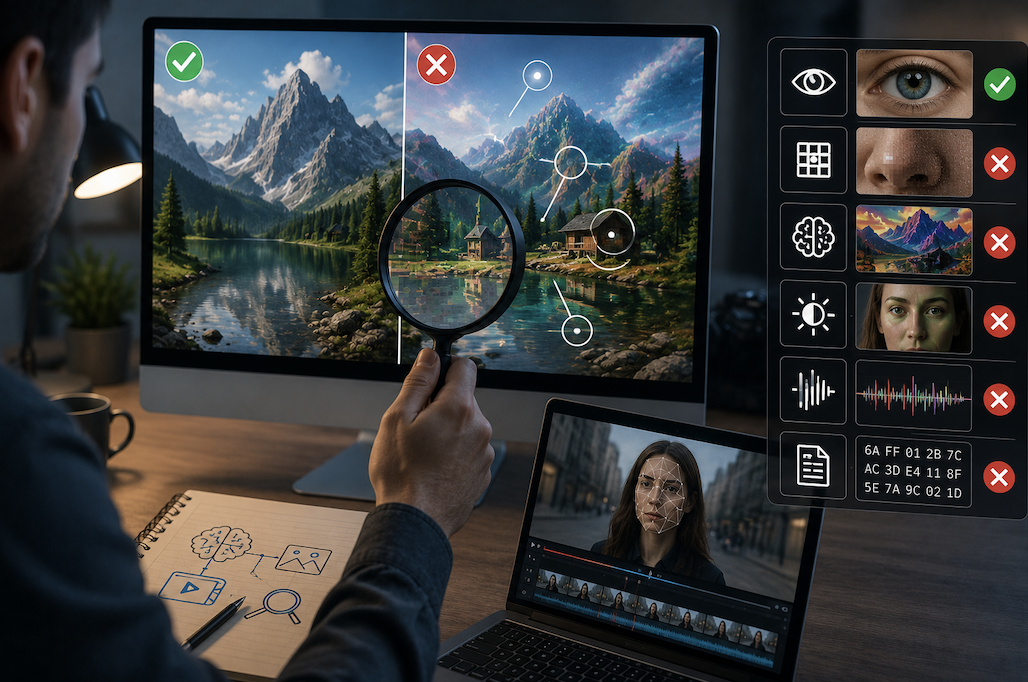
While AI generation quality has improved significantly, certain visual inconsistencies still commonly appear, particularly in less sophisticated examples, providing genuinely useful detection signals worth checking.
- Unnatural or inconsistent hands, fingers, or other complex anatomical details
- Text appearing within an image that looks garbled, nonsensical, or inconsistently rendered
- Backgrounds or secondary elements that appear subtly distorted or inconsistent with the main subject
- Lighting or shadow patterns that do not logically match across different elements within the same image
Hand and finger rendering deserves particular mention, since this specific detail has historically proven genuinely challenging for AI image generation systems to render consistently and anatomically correctly, making unusual hand positioning or an incorrect number of fingers one of the more reliable, though not entirely foolproof, detection signals available.
Why Checking Image Metadata Can Provide Genuine Clues
Beyond visual inspection alone, examining an image’s underlying technical metadata can sometimes provide genuinely useful additional information about its actual origin and creation process.
- Some AI generation tools embed metadata indicating the image was artificially created
- Genuine photographs typically contain metadata from the actual camera or device used to capture them
- Missing or inconsistent metadata does not definitively prove AI generation but can serve as a useful additional signal
- Some platforms and tools specifically strip metadata during upload, limiting this verification method’s reliability
How Context and Source Verification Genuinely Complement Visual Analysis
Understanding that verifying an image’s actual source and surrounding context often provides more reliable information than visual analysis alone becomes increasingly important as AI generation quality continues improving.
- Search for the same image across multiple sources to see if its origin can be genuinely traced
- Consider whether the image’s claimed context and timing actually make logical sense
- Be suspicious of images that appear suddenly without any credible, traceable originating source
- Reverse image search tools can sometimes reveal whether an image has appeared elsewhere previously
This contextual verification deserves particular emphasis specifically because it becomes considerably more reliable than purely visual detection as AI generation technology continues advancing, since even a technically flawless AI-generated image cannot fabricate a genuine, verifiable trail of prior appearances and credible sourcing.
Emerging Technical Detection Tools Worth Understanding
Recognizing the genuine, ongoing challenge AI-generated content presents, various technical tools and approaches have been developed specifically to help identify this content more reliably than manual visual inspection alone.
- AI-based detection tools analyze subtle statistical patterns that may not be visually obvious to human observers
- Digital watermarking technologies are being developed specifically to help verify authentic, unmanipulated content
- Some platforms have implemented labeling requirements for content identified as AI-generated
- This detection technology remains an ongoing, evolving effort as generation technology continues advancing simultaneously
Why Video Detection Presents Additional Genuine Challenges
Understanding that AI-generated video introduces additional complexity beyond static images helps explain why video verification often requires somewhat different considerations and techniques.
- Video requires maintaining visual consistency across many sequential frames, a genuinely more complex technical challenge
- Motion and temporal consistency can sometimes reveal inconsistencies not visible in a single static frame
- Audio components, when present, provide an additional avenue for potential detection through inconsistencies
- Video length and complexity often mean more opportunities for detectable inconsistencies to actually appear somewhere within the content
Practical Steps for Evaluating Suspicious Visual Content
- Examine complex details like hands, text, and background elements for visual inconsistencies
- Check available metadata when possible, though treat its absence as inconclusive rather than definitive
- Search for the image or video’s origin across multiple independent sources
- Consider whether the content’s claimed context and timing genuinely make logical sense
- Apply particular scrutiny to content that seems designed to provoke a strong emotional reaction
Why Understanding the Purpose Behind Content Adds Genuine Verification Value
Beyond purely technical detection methods, considering why a specific piece of content might exist and who genuinely benefits from its circulation provides an additional, often underutilized layer of verification worth incorporating into your evaluation process.
Content that seems specifically designed to provoke strong emotional reactions, confirm existing biases, or push a viewer toward a specific action deserves particular scrutiny, regardless of how technically convincing the actual image or video appears. This motivational analysis complements technical detection methods genuinely well, since sophisticated AI-generated content specifically created to deceive is often deployed within a broader context designed to manipulate, meaning understanding this broader intent can flag content worth deeper scrutiny even when the visual inconsistencies alone might not be immediately obvious.
- Considering who benefits from a piece of content’s circulation adds a valuable verification dimension
- Content designed to provoke strong emotions or confirm biases deserves particular additional scrutiny
- This motivational analysis complements, rather than replaces, technical visual detection methods
- Understanding broader intent helps flag content worth deeper scrutiny even when visually convincing
Final Thoughts
Spotting AI-generated images and video requires combining careful visual inspection of common inconsistencies with genuine source verification and contextual analysis, since relying on visual detection alone becomes increasingly unreliable as generation technology continues advancing rapidly. Developing this combined verification habit, rather than depending on any single detection method, provides the most practical, currently reliable approach to navigating an increasingly complex visual media landscape where distinguishing authentic from artificially generated content has become a genuinely important modern media literacy skill.
As this technology continues evolving on both the generation and detection sides, staying reasonably informed about current capabilities and limitations, rather than relying on outdated assumptions about what AI can or cannot convincingly produce, remains one of the most practical ongoing habits for navigating this genuinely fast-moving landscape.
Frequently Asked Questions
1. Is it becoming genuinely impossible to detect AI-generated images visually?
Detection has become considerably more difficult as generation technology improves, though most current AI-generated content still contains at least some detectable inconsistencies, making this an ongoing challenge rather than an already lost cause, particularly when combined with contextual verification.
2. Do all AI image generation tools produce content that includes identifying metadata?
No, this varies considerably by specific tool and platform, with some embedding clear identifying information while others do not, meaning metadata absence should be treated as inconclusive rather than proof of authenticity.
3. Can AI-generated video be detected the same way as AI-generated still images?
While some detection principles overlap, video introduces additional complexity around maintaining consistency across many frames, meaning video-specific verification often benefits from examining motion consistency and audio elements alongside standard visual inspection.
4. Are there reliable automated tools available for verifying whether specific content is AI-generated?
Various detection tools exist and continue improving, though this remains an evolving technical area without a single universally reliable solution, making combining multiple verification approaches, including manual inspection and source checking, genuinely more reliable than relying on any single automated tool alone.
5. Why do hands and fingers remain a commonly cited detection signal despite AI improvements?
Rendering anatomically correct, consistent hands involves genuinely complex spatial reasoning that has historically challenged AI generation systems more than other visual elements, though this specific weakness has been improving considerably with more recent generation technology.