A group chat between an iPhone user in Chicago and three Android-owning cousins used to mean blurry photos, no typing indicators, and a stray “Emphasized ‘dinner at 7′” message nobody could parse. In late 2024, Apple flipped on RCS support in iOS, and the same group thread suddenly showed read receipts, full-resolution images, and reactions that rendered as actual emoji instead of garbled text.
Nobody in the group installed an app or changed a setting beyond updating their phone software. That quiet shift, arriving inside the default Messages app on both platforms, is the clearest sign yet that the decades-old SMS standard is finally being replaced under the hood.
A Long Overdue Successor to SMS
SMS was designed in the 1980s for a network built around voice calls, with a 160-character limit and no native support for anything beyond plain text. Every workaround since then, from MMS for photos to third-party apps for everything else, existed because the underlying carrier protocol never grew up. Rich Communication Services, or RCS, is the GSM Association’s answer: a messaging standard that runs over mobile data instead of the old signaling channel, built with the features people now expect from any modern chat app.
The features RCS brings to a standard text thread include:
- High-resolution media: photos and videos sent without the aggressive compression SMS and MMS impose.
- Typing indicators and read receipts: visible signals that a conversation partner is responding.
- Larger group chats: threads that behave more like a proper group conversation than a fragile SMS chain.
- Reactions: tap-to-react emoji instead of an auto-generated text message describing the reaction.
- Message-level delivery over Wi-Fi: texts that send and receive on Wi-Fi-only devices without a cellular plan.
Carrier Roots and Google’s Push
RCS technically dates back to 2007, developed by an industry group as a carrier-level replacement for SMS. For over a decade, it went nowhere fast, held back by patchy carrier support and no unified backend connecting one network’s implementation to another’s. Google changed the trajectory around 2019 by building its own RCS infrastructure, called Jibe, and rolling it into the Messages app on Android regardless of whether a person’s carrier had bothered to support the standard. That move effectively made Google the default RCS provider for most Android users, sidestepping years of fragmented carrier rollout.
Apple resisted for years, arguing that iMessage already delivered a superior experience for iPhone users messaging each other and that RCS added complexity without matching iMessage’s encryption. Regulatory pressure in the European Union, combined with mounting criticism over the “green bubble” experience for cross-platform group chats, eventually pushed Apple to add RCS support starting with iOS 18. The result is a rare case of two competing platforms adopting a shared standard not because they wanted the same technology, but because customers on both sides had grown tired of second-class group chats.
Encryption Gaps Still Being Closed
RCS solved most of SMS’s feature gaps, but its encryption story remains a work in progress. Messages between two Android users on Google’s Messages app get end-to-end encryption automatically, the same protection iMessage has offered since 2011. Cross-platform RCS messages between an iPhone and an Android device, however, did not carry that same guarantee at launch, since Apple and Google each maintain separate implementations that were not initially built to interoperate on encryption.
That gap matters because it changes what a message protects against in real terms:
- Same-platform RCS (Android to Android): end-to-end encrypted through Google’s implementation, unreadable to carriers or Google itself in transit.
- iMessage to iMessage: end-to-end encrypted using Apple’s own protocol, unrelated to RCS entirely.
- Cross-platform RCS (iPhone to Android): encrypted in transit between device and server in most current deployments, but the guarantee has historically been weaker than same-platform messaging until the GSMA’s universal profile for encryption matures across both ecosystems.
- Plain SMS/MMS fallback: no meaningful encryption at all, and still the fallback whenever RCS isn’t available on either end.
Both companies have committed to closing this gap through a shared encryption standard developed with the GSMA, but the timeline for full parity across every carrier and device combination has moved slower than either side originally suggested.
Regional Coverage and Network Variation
Coverage for RCS is not uniform, and a feature working flawlessly in one country can behave inconsistently in another. Carriers in the United States, most of Western Europe, and much of East Asia have largely adopted RCS either directly or by riding on Google’s Jibe backend. Some markets still lean heavily on SMS and MMS because local carriers have been slow to certify RCS profiles, or because a significant share of devices in circulation are older models that never received the software needed to support it.
- Fully supported markets: most major US carriers, UK operators, and large parts of the EU, where RCS works out of the box on recent devices.
- Partial support: regions where RCS works on some carriers but falls back to SMS on others within the same country.
- Limited support: markets where older network infrastructure, regulatory hurdles, or carrier reluctance keep RCS adoption low.
- Wi-Fi-only fallback: travelers roaming outside their home network sometimes lose RCS entirely, dropping back to SMS until a compatible connection resumes.
Anyone messaging across borders should expect some inconsistency until adoption becomes closer to universal, which is still likely a matter of years rather than months. International roaming adds another layer of unpredictability, since a phone that supports RCS at home may quietly fall back to SMS while abroad if the visited network hasn’t negotiated support with the home carrier’s backend, something travelers rarely notice until a photo fails to send in high resolution.
Business Messaging and a New Ad Channel
RCS isn’t only a consumer feature. Google has positioned RCS Business Messaging as a richer alternative to SMS marketing and customer service texts, letting companies send branded messages with logos, carousels of product images, and quick-reply buttons instead of a plain block of text. Airlines, delivery services, and retailers have started adopting it for shipment tracking and appointment reminders, since a verified business sender with a logo is both more trustworthy-looking and more actionable than an anonymous ten-digit number.
This shift raises the same questions that email marketing went through years earlier. Verified business RCS senders reduce some of the risk that comes with impersonation, since a properly verified account displays a checkmark and business name, but it also opens a new front for spam and phishing attempts that mimic those same verified badges. Carriers and Google have built review processes for business accounts, though the system is young enough that enforcement is still catching up to the volume of businesses trying to adopt it.
Marketing teams have taken notice for a simpler reason: engagement. A branded message with a product carousel and a tappable button tends to outperform a plain SMS link, if only because it looks less like the generic spam texts people have learned to ignore. Customer service departments have adopted it for similar reasons, using RCS to send package tracking with an embedded map or a support conversation that can escalate into a live chat without leaving the thread. The downside is that as more legitimate businesses adopt rich messaging, scammers gain a template to imitate, and recipients will need the same skepticism they’ve developed for suspicious emails and links.
Practical Differences From iMessage and WhatsApp
Comparing RCS to the messaging apps people already rely on clarifies what it replaces and what it doesn’t. iMessage remains an Apple-exclusive protocol that only ever worked between Apple devices, with RCS filling the gap for messages that leave that ecosystem. WhatsApp and Signal, by contrast, are cross-platform apps that work identically regardless of phone brand, but they require both parties to install the app and create an account, something RCS avoids by working through the native Messages app tied to a phone number.
None of these apps are mutually exclusive, and most people end up using two or three depending on who they’re talking to. A family group chat might stay on RCS or iMessage because that’s where everyone already is, while a work team defaults to Slack or a dedicated app, and a small circle of privacy-focused friends sticks with Signal for anything sensitive. RCS’s real contribution is raising the floor for the default option rather than trying to pull people away from apps they’ve already chosen.
The trade-off comes down to a few consistent factors:
- Default availability: RCS works through the phone’s built-in messaging app with no separate install, while WhatsApp and Signal need a dedicated app and account setup.
- Cross-platform consistency: WhatsApp and Signal behave identically on iPhone and Android since both are controlled by a single company, while RCS depends on how well Apple’s and Google’s implementations interoperate.
- Encryption guarantees: Signal offers the strongest default encryption with no cross-platform gap, while RCS’s protection still varies depending on which two platforms are messaging each other.
- Global reach: WhatsApp dominates in much of Latin America, Europe, and Asia regardless of carrier or device, while RCS adoption still tracks more closely with carrier and regional support.
What Adoption Means for Everyday Messaging
For most people, the practical effect of RCS shows up in small but constant ways: photos that don’t look like they were sent through a fax machine, group chats that don’t fracture into a dozen separate SMS threads, and read receipts that finally work across phone brands. None of that requires the sender or recipient to think about the underlying protocol at all, which is exactly the point. The best infrastructure upgrades are the ones nobody has to configure.
The rollout still carries some friction worth expecting. Older phones that never receive a software update capable of supporting RCS will keep falling back to SMS indefinitely, and travelers moving between countries with different levels of carrier support may see features toggle on and off depending on network conditions. Full encryption parity between iPhone and Android messaging is close but not fully finished across every carrier combination, which means privacy-conscious users messaging across platforms may still prefer Signal or WhatsApp for truly sensitive conversations until that gap closes for good.
Device Support, Timelines, and Everyday Signals
Software alone doesn’t guarantee RCS works on any given phone. A device needs both an operating system version capable of supporting the protocol and a carrier profile that has been properly configured to recognize it, and older hardware sometimes falls short on the first requirement even when the carrier has done its part. Budget phones sold in price-sensitive markets often ship with older Android builds that never receive the update needed for full RCS support, leaving buyers stuck on SMS regardless of their carrier’s own capabilities.
The rollout timeline also looks quite different between the two major platforms. Google enabled RCS gradually across Android starting in 2019, initially through regional tests before expanding worldwide, and the feature has now been standard on new Android phones for several years. Apple’s adoption arrived far later and initially launched with acknowledged gaps, including the encryption shortfall for cross-platform threads, with the company stating publicly that a fuller implementation would follow as the GSMA’s encryption standard matured.
Buyers of new phones today can generally assume RCS support out of the box, but anyone using a phone more than a few years old should check rather than assume. Carrier-branded messaging apps that predate RCS’s mainstream rollout can also complicate things, since a phone might technically support the protocol at the hardware level while its default app never negotiates it correctly, requiring a switch to Google Messages or a manual settings change to unlock the feature.
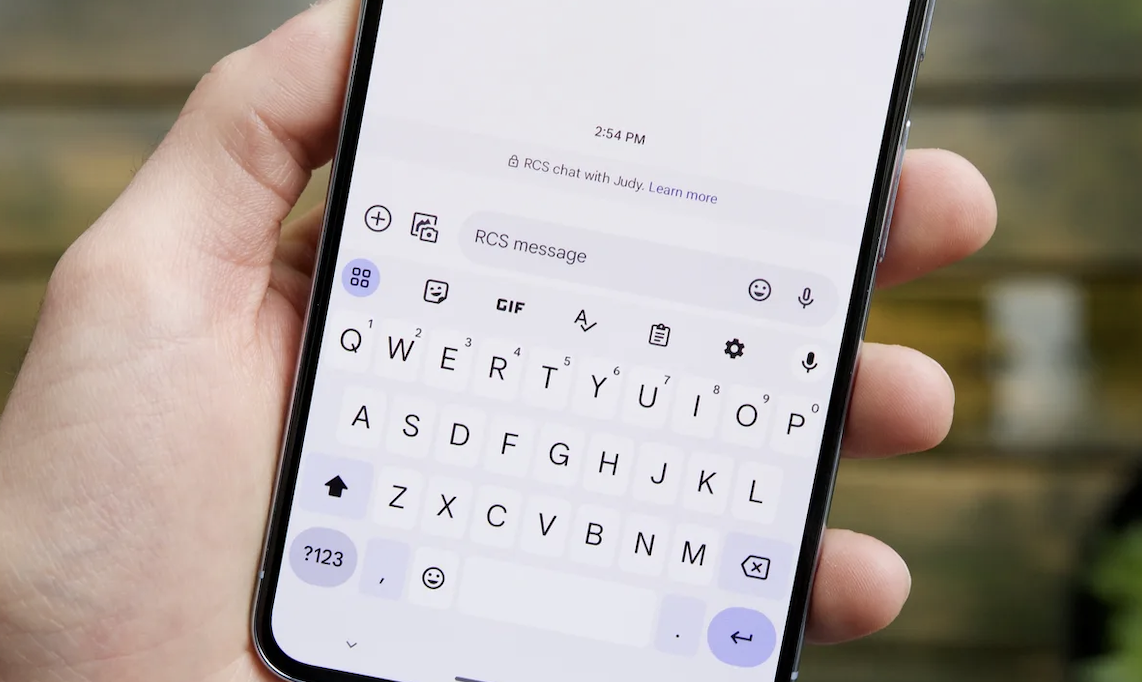
Most people never manually confirm which protocol a given text thread is using, but the visual cues are consistent enough to check quickly. On an iPhone, a conversation using RCS shows a blue bubble but includes features like read receipts and typing indicators that plain SMS never had, distinguishing it from a legacy green SMS bubble. On Android’s Messages app, a small label or icon near the send button typically indicates whether a chat is running over RCS or has fallen back to SMS, and switching between Wi-Fi and cellular can sometimes trigger that fallback temporarily.
A few situations reliably signal that RCS isn’t active for a given conversation:
- A contact recently switched phones or carriers: registration with the RCS backend can take a few minutes to refresh.
- One party has RCS disabled in settings: even if their device supports it, a manually disabled toggle forces SMS fallback for that person.
- Weak or no data connection: RCS depends on mobile data or Wi-Fi, so a message sent with no data connectivity reverts to SMS if available.
- An outdated messaging app: a phone running an old version of Google Messages or a carrier-branded app not built for RCS won’t negotiate the protocol correctly.
Final Thoughts
RCS is less a flashy new feature than a long-delayed repair job on infrastructure most people never think about until it fails them. The shift from SMS brings texting roughly in line with what chat apps have offered for over a decade, without asking anyone to install anything new or abandon the app they already open by default.
Full encryption parity across every platform combination and universal carrier support are still catching up, and travelers or owners of older phones will keep hitting inconsistencies for a while yet. Even with those rough edges, the direction is clear: the humble text message is finally getting the upgrade it was owed.
Frequently Asked Questions
1. Does RCS replace iMessage on the iPhone?
No. iMessage remains the default for messages between two Apple devices and keeps its own encryption and features. RCS only activates automatically for messages to non-Apple phones that previously would have fallen back to plain SMS.
2. Is RCS free to use?
RCS runs over mobile data or Wi-Fi rather than the older SMS signaling channel, so it typically doesn’t count against SMS limits, but data usage still applies on a cellular connection. Most modern data plans make this cost negligible for text-based messaging.
3. Can I turn RCS off if I prefer SMS?
Yes, both Android’s Messages app and iOS’s Messages settings include a toggle to disable RCS chat features and fall back to standard SMS and MMS. Turning it off removes read receipts, typing indicators, and high-resolution media for outgoing messages.
4. Why did group chats with iPhones look broken before RCS?
Older cross-platform group chats relied on SMS or MMS, which handled group messaging poorly and degraded photos and videos through heavy compression. RCS replaces that fallback with a protocol built for modern group conversations, fixing most of those visible problems at once.
5. Does RCS work the same on every carrier?
Not entirely. Coverage and feature support vary by country and carrier, with some markets offering full RCS functionality and others still leaning on SMS due to slower certification or older network equipment. Checking both parties’ carrier support explains most inconsistent behavior.
6. Is RCS as private as Signal or WhatsApp?
Same-platform RCS messaging between two Android devices is end-to-end encrypted, but cross-platform messages between iPhone and Android have historically had weaker guarantees than dedicated encrypted apps. Anyone with strict privacy requirements should still prefer Signal for sensitive conversations until full cross-platform encryption parity is confirmed.