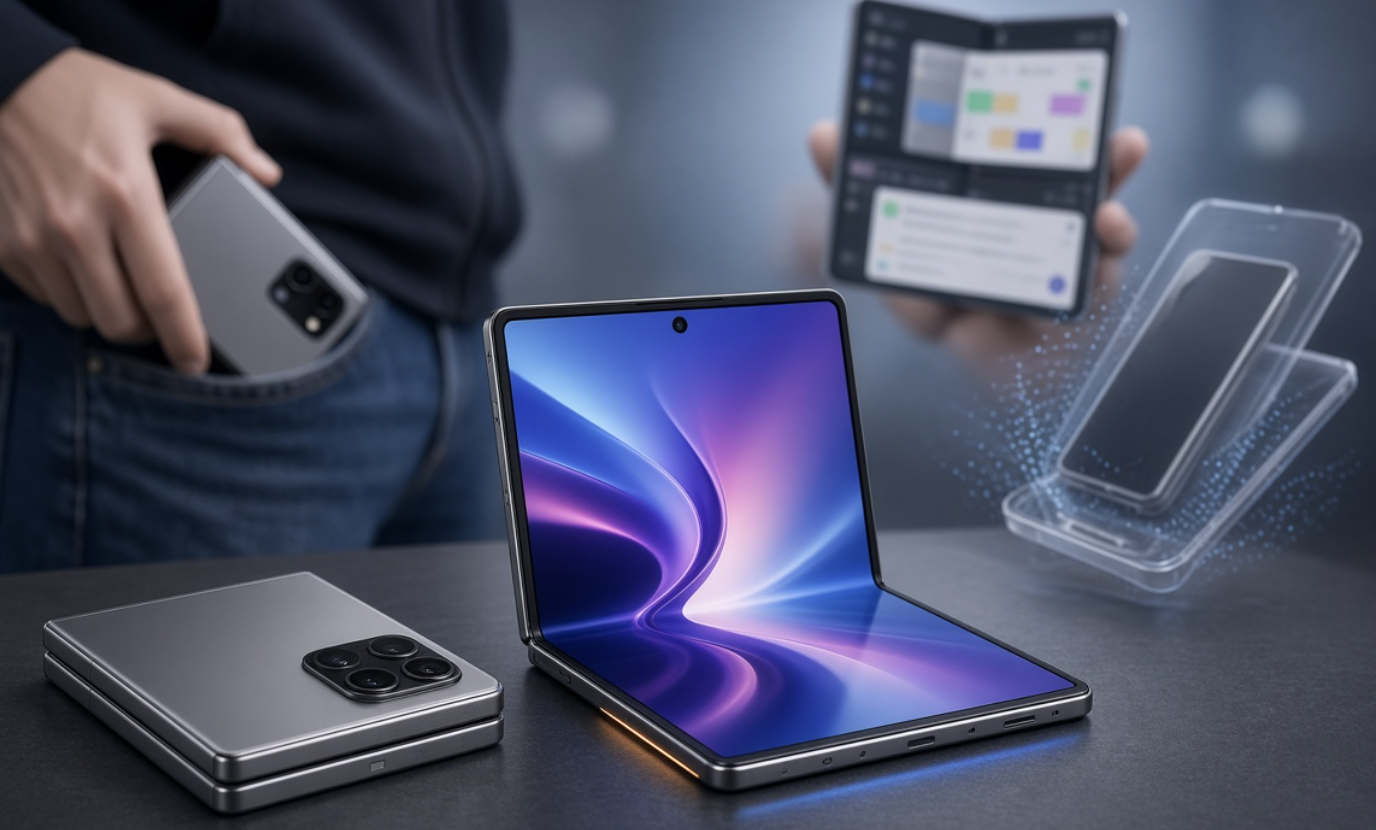
A commuter on a crowded train pulls a Samsung Galaxy Z Fold from a coat pocket, unfolds it into a tablet-sized screen to read a document, then folds it shut and slips it back before the next stop.
Three years ago that same motion would have drawn stares and a flinch from anyone who remembered the first generation of folding phones, with their crease lines, floppy hinges, and screens that seemed one bad drop away from failure.
By 2026, the anxiety has mostly faded, not because the physics of a folding screen became simple, but because several years of iteration quietly solved most of the problems that made early adopters nervous in the first place.
Where the Category Stands Today
The foldable phone market has moved well past the experimental phase it occupied when Samsung and Huawei first shipped consumer devices. What started as a novelty aimed at early adopters willing to pay a premium for a party trick has turned into a legitimate product category with multiple competing form factors, each solving for a different use case.
Samsung’s Z Fold and Z Flip lines remain the most recognizable in Western markets, while Huawei, Honor, Oppo, and Xiaomi have pushed the category aggressively in China, often shipping thinner and lighter devices than their Western counterparts.
Two form factors have emerged as the dominant approaches:
- Book-style folds: phones that open like a small book into a larger tablet-style screen, exemplified by the Galaxy Z Fold and Huawei’s Mate X series.
- Flip-style folds: compact phones that fold vertically to roughly half their open size, fitting into a pocket the way a classic flip phone once did, led by the Galaxy Z Flip and Motorola’s Razr line.
- Tri-fold designs: a newer category, with devices from Huawei and Samsung folding twice to reach an even larger unfolded screen, still working through early durability questions.
Hinge Engineering as the Real Battleground
If there’s a single component that determines whether a folding phone feels premium or fragile, it’s the hinge. Early hinges left a visible gap when closed, collected dust and debris that could scratch the screen, and wore down faster than the rest of the phone, sometimes developing a wobble within a year of daily use.
Manufacturers have thrown enormous engineering effort at fixing this, and the improvement shows up in ways a spec sheet doesn’t always capture well.
Modern hinge designs address the old complaints through a few consistent strategies:
- Water-drop hinges: mechanisms that let the screen fold into a teardrop shape rather than a sharp crease, reducing stress on the display panel at the fold point.
- Dust-sealing gaskets: small brushes or seals along the hinge opening that keep particles from working their way into the mechanism over time.
- Titanium and reinforced alloys: structural materials that cut weight while improving resistance to the metal fatigue that plagued earlier designs.
- Higher rated fold cycles: independent testing labs and manufacturers alike now publish fold-cycle durability numbers, with current generation hinges routinely rated for hundreds of thousands of folds under lab conditions.
None of this makes a folding phone as structurally simple as a slab phone with no moving parts, but the gap has narrowed enough that hinge failure is no longer the first thing a buyer should worry about. Independent teardown channels and repair specialists like iFixit have documented this shift directly, noting that hinge assemblies on recent Galaxy Fold and Pixel Fold models show noticeably tighter tolerances and fewer failure points than the mechanisms found in devices from just a few years earlier.
Screen Materials and the Crease Question
The crease down the center of a folding display was the most visible reminder that the technology hadn’t fully matured, and it remains the single feature buyers ask about most before purchasing. Ultra-thin glass, first introduced by Samsung on the Z Flip 3 and refined across subsequent generations, replaced the plastic protective layer used on the earliest folding screens, offering better scratch resistance while still remaining flexible enough to fold thousands of times.
The crease itself hasn’t disappeared entirely, but it has become far less pronounced through changes in hinge geometry that reduce how sharply the display bends at its center point. Under direct light at certain angles, a faint line is still visible on most current-generation foldables, and that’s likely to remain true until display makers find a way to increase the fold radius without also increasing the phone’s closed thickness. For most daily use, though, the crease has moved from a constant visual annoyance to something users report noticing only when they specifically look for it.
Weight, Thickness, and the Pocketability Trade-Off
Every foldable phone carries an inherent design tax compared to a traditional slab phone: two screens’ worth of components, a hinge mechanism, and often a thicker overall profile even when open. Early Galaxy Fold models felt noticeably bulkier than a standard flagship phone, and that extra heft was one of the most common complaints from reviewers and early buyers alike.
Recent generations have chipped away at this steadily. Chinese manufacturers in particular pushed thinness aggressively, with devices from Honor and Oppo shipping folded thicknesses that rival some non-folding phones, forcing Samsung to respond with its own slimmer redesigns. The trade-offs buyers still weigh when comparing options include:
- Folded thickness: how bulky the phone feels in a pocket when closed, now often under 12mm on flagship book-style foldables.
- Overall weight: still typically heavier than a comparable slab flagship, though the gap has shrunk from roughly 50 grams to closer to 20 in top models.
- Battery capacity trade-offs: thinner designs sometimes mean smaller batteries, forcing a compromise between slimness and battery life.
- Case and accessory availability: foldables still lag behind traditional phones in third-party case options, though this has improved as the category has grown.
Software Adaptation Across a Changing Shape
A folding phone is only as good as the software running on it, and this has historically been foldables’ quieter weak point. Android app developers spent years designing exclusively for fixed rectangular screens, and early folding phones suffered from apps that looked stretched, cropped, or simply broken when the screen unfolded into its larger tablet mode. Google has pushed hard on this through updated developer guidelines and testing tools bundled into Android, and the difference shows up in how well current apps adapt compared to what shipped alongside the first Galaxy Fold.
Multitasking has become one of the strongest arguments in favor of the book-style form factor specifically. Running two or three apps side by side on an unfolded screen, dragging a file between them, or continuing a task started on the cover screen and finishing it on the main display are all now smooth enough to feel like a real productivity gain rather than a gimmick layered on top of a phone.
Apple’s rumored entry into the category has added pressure on the whole ecosystem, since a foldable iPhone would force iOS developers to solve the same adaptive layout problems Android developers have spent years working through already. That pressure alone has already nudged some app makers to prioritize flexible layouts ahead of any confirmed Apple launch, treating foldable support as a forward-looking investment rather than a niche accommodation for a small slice of the Android market.
Comparing Flip and Fold Buyers
The two dominant form factors attract distinctly different buyers, and that split explains why manufacturers keep both lines alive rather than consolidating around one design. Flip-style phones sell largely on compactness and style, appealing to buyers who want a phone that’s noticeably smaller in the pocket and who value the novelty of a clamshell design more than raw productivity gains. Book-style folds sell on the tablet-sized screen itself, drawing buyers who want a real multitasking device that can replace a small tablet for reading, note-taking, or split-screen work.
- Flip buyers: prioritize pocketability, style, and a lower price point relative to book-style foldables.
- Fold buyers: prioritize screen real estate, multitasking, and are typically willing to pay a premium closer to $1,800 to $2,000.
- Crossover buyers: a growing segment purchasing a fold specifically to replace both a phone and a small tablet, cutting down on the number of devices they carry.
Pricing and the Path to the Mainstream
Foldable phones remain a premium category, and pricing is the biggest single barrier keeping them from mainstream adoption in Western markets. A flagship book-style fold typically costs several hundred dollars more than an equivalent non-folding flagship, a gap that reflects both the added component cost and the lower manufacturing yields that come with a more complex assembly process.
Flip-style phones have positioned themselves closer to mainstream flagship pricing, which is part of why they’ve captured a larger share of first-time foldable buyers than the pricier book-style models.
China’s market has shown what happens when domestic competition drives prices down faster than Western markets have managed. Honor, Oppo, and Xiaomi compete aggressively on foldable pricing within China, and that competitive pressure has pushed the entire category toward thinner, lighter, and cheaper devices faster than would have happened with Samsung as the only serious player.
As component costs continue dropping and more manufacturers enter the category globally, the price gap between foldable and traditional flagships is expected to keep narrowing, though it’s unlikely to close entirely within the next product cycle or two.
Trade-in programs have become another quiet lever manufacturers use to soften the sticker shock. Samsung, Google, and Motorola all run aggressive trade-in credits toward a foldable purchase, sometimes covering a large share of the retail price for a customer upgrading from an older flagship, which has done more to move first-time buyers into the category than any single hardware improvement.
Carriers have followed a similar playbook, bundling foldables into installment plans that spread the premium out over two years rather than asking buyers to absorb the full cost upfront, a tactic borrowed directly from how flagship slab phones became mainstream a decade earlier.
Repair Costs, Battery Life, and Long-Term Ownership
Owning a folding phone comes with a maintenance reality that slab-phone buyers rarely have to think about. A cracked screen on a foldable typically costs more to repair than an equivalent repair on a traditional flagship, since the inner display is a specialized flexible panel rather than a standard piece of glass, and the hinge assembly adds another component that can fail independently of the screen itself. Samsung, Google, and other manufacturers have expanded their official repair programs and extended warranty options specifically because foldable owners have historically been more anxious about long-term reliability than buyers of conventional phones.
Third-party insurance and protection plans have caught up to the category as well, with several carriers now offering foldable-specific coverage that accounts for the higher repair costs. A few practical habits have emerged among experienced foldable owners looking to extend a device’s working life:
- Avoid pressing hard on the folded screen: the inner display sits closer to the surface than a standard glass panel and is more sensitive to point pressure.
- Keep the hinge area clear of debris: pocket lint and sand are the most common causes of grinding or resistance in a hinge over time.
- Use a case designed for the specific model: generic cases rarely account for the hinge mechanism and can interfere with how the phone folds.
- Watch for software updates: manufacturers periodically release fixes that address hinge calibration or display refresh issues discovered after launch.
Fitting two display panels and a hinge mechanism into a phone leaves less internal space for battery capacity than a traditional design enjoys, and that constraint used to show up clearly in real-world battery life. Early foldables often struggled to make it through a full day of moderate use, especially when the larger inner screen stayed active for extended reading or video sessions.
Manufacturers have responded with more efficient processors, dual-cell battery designs that better use the irregular internal space created by the hinge, and software optimizations that dim or pause the unused screen automatically when a phone is folded.
Buyers comparing foldables on battery performance tend to notice a few consistent patterns. Flip-style phones generally see less of a battery penalty than book-style folds, since their smaller cover screen uses less power for quick glanceable tasks like checking notifications without needing to unfold the phone at all.
Book-style folds benefit more from fast charging support to offset their comparatively higher power draw during heavy tablet-mode use, and most current flagship foldables now support charging speeds roughly on par with non-folding flagships from the same manufacturer, closing a gap that used to be far more noticeable.
Final Thoughts
Foldable phones spent their first few years proving the concept could work at all, and the current generation is finally answering the more practical question of whether it works well enough for someone to rely on every day. Hinge durability, screen materials, and software support have all closed much of the gap that made early adopters nervous, even if price and a still-visible crease remain honest trade-offs buyers should weigh.
The category has settled into two clear lanes, one built around pocketable style and the other around tablet-sized productivity, giving buyers a real choice rather than a single compromise.
Whether foldables become the default phone shape or stay a premium alternative likely comes down to how fast pricing keeps falling from here.
Read more TechNewWeb
Frequently Asked Questions
1. Are foldable phones durable enough for daily use in 2026?
Current-generation foldables have improved by a wide margin over early models, with hinges rated for hundreds of thousands of fold cycles and better dust and scratch resistance on the display. They’re still more delicate than a traditional slab phone with no moving parts, so a protective case remains a sensible precaution.
2. Does the screen crease go away over time?
The crease doesn’t disappear, but improved hinge geometry has made it far less noticeable in daily use than on early models. It tends to be visible mainly under direct light at specific angles rather than during normal use.
3. Which foldable form factor is better for productivity?
Book-style folds like the Galaxy Z Fold offer more screen space for multitasking, split-screen apps, and note-taking, making them the stronger choice for productivity-focused buyers. Flip-style phones prioritize compactness and style over the extra screen real estate.
4. Why are foldable phones still so expensive?
The added hinge mechanism, dual-screen components, and lower manufacturing yields compared to traditional phones all add to production cost. Chinese manufacturers have pushed prices down faster through aggressive domestic competition, and that pressure is gradually affecting global pricing too.
5. Do all apps work properly on a foldable screen?
Most major apps have been updated to adapt to a foldable’s changing aspect ratio, but some smaller or less-maintained apps still display awkwardly when the screen unfolds. Google’s developer guidelines have pushed adoption forward much faster than in the category’s early years.
6. Is Apple expected to release a foldable iPhone?
Reports and supply chain leaks have pointed toward Apple entering the foldable category, though the company has not confirmed a release date as of 2026. Its entry would likely accelerate software adaptation across the wider app ecosystem, similar to how past Apple launches have reshaped expectations for an entire category.