Software as a service, commonly abbreviated as SaaS, has become one of the dominant business models across the technology industry, yet many people outside the software world genuinely struggle to understand exactly how this model actually generates revenue and why it has proven so consistently successful. Understanding the genuine mechanics behind SaaS reveals why this approach has fundamentally reshaped how software gets sold and delivered.
What the SaaS Business Model Actually Means
SaaS refers to a software delivery model where customers access software through the internet, typically paying a recurring subscription fee, rather than purchasing a one-time license and installing the software directly on their own devices. The software itself runs on the provider’s servers, with customers accessing it remotely through a web browser or dedicated application connecting to these centrally hosted systems.
This represents a genuinely fundamental shift from the traditional software business model, where customers historically paid a single upfront fee for a permanent license, then often needed to purchase upgrades separately as new versions became available, creating a considerably different, more sporadic revenue pattern for software companies compared to the SaaS model’s more predictable, ongoing structure.
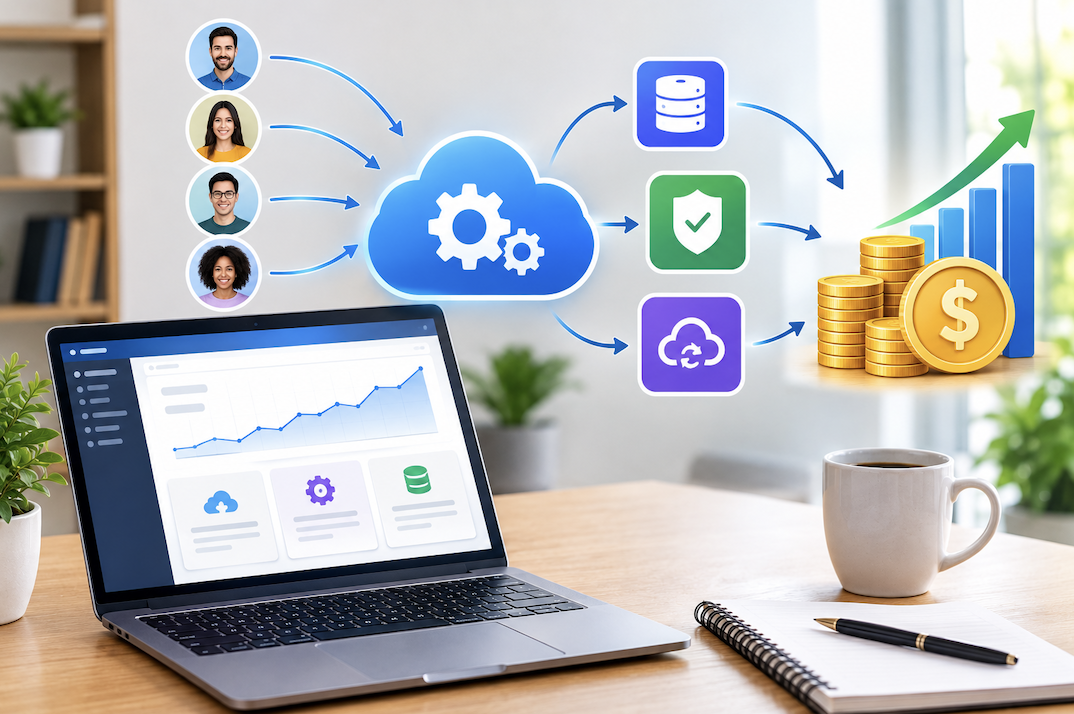
How SaaS Companies Actually Generate Revenue
Understanding the genuine revenue mechanics behind SaaS businesses helps clarify why this model has proven so consistently attractive to both software companies and investors evaluating these businesses.
- Customers pay a recurring subscription fee, typically billed monthly or annually
- This creates predictable, recurring revenue rather than the more sporadic, one-time payments traditional software sales generated
- Many SaaS companies offer tiered pricing, with different feature sets available at different price points
- Additional revenue often comes from add-on features, increased usage limits, or expanded user seats
This recurring revenue predictability deserves particular emphasis, since it represents one of the most genuinely significant advantages of the SaaS model from a business perspective, allowing companies to more accurately forecast future revenue and plan accordingly, compared to the considerably less predictable revenue patterns traditional one-time software licensing historically generated.
Why the SaaS Model Genuinely Benefits Both Companies and Customers
Understanding the mutual, genuine benefits this model provides helps explain why it has become so dominant across the software industry rather than simply benefiting providers at customers’ expense.
- Customers avoid high upfront costs, instead paying smaller, more manageable ongoing fees
- Software updates and improvements get delivered automatically, without requiring manual installation
- Companies benefit from predictable revenue that supports more stable, sustainable long-term planning
- This ongoing relationship incentivizes companies to continuously improve their product to retain subscribers
This continuous improvement incentive genuinely matters, since a SaaS company’s revenue depends on customers continuing their subscription rather than a single initial purchase, creating a genuine, ongoing incentive to keep improving the product and maintaining customer satisfaction, rather than the comparatively weaker incentive traditional one-time software sales provided once the initial purchase was already complete.
Understanding Key Metrics That Genuinely Matter for SaaS Businesses
SaaS companies track several specific metrics that provide genuine insight into business health and growth potential, metrics that differ meaningfully from those relevant to traditional one-time sale businesses.
- Monthly recurring revenue, tracking the predictable revenue generated from active subscriptions each month
- Customer churn rate, measuring what percentage of customers cancel their subscription over a given period
- Customer lifetime value, estimating the total revenue a typical customer generates over their entire subscription relationship
- Customer acquisition cost, measuring how much it genuinely costs to acquire each new paying customer
Churn rate deserves particular attention among these metrics, since even a seemingly modest monthly churn rate can genuinely compound into a significant challenge over time, meaning SaaS companies invest considerably in customer retention efforts, since acquiring a new customer typically costs considerably more than retaining an existing one already generating recurring revenue.
Why Customer Retention Matters More in SaaS Than Traditional Software Sales
Understanding why SaaS companies genuinely prioritize customer retention differently than traditional software businesses helps explain many of the specific product and support decisions these companies typically make.
- Revenue depends on customers continuing their subscription, not just completing an initial purchase
- A traditional software sale generates its full revenue immediately, regardless of subsequent customer satisfaction
- SaaS revenue is genuinely at ongoing risk if customer satisfaction declines and subscriptions get canceled
- This creates strong, ongoing incentives for continuous product improvement and genuinely responsive customer support
Common SaaS Pricing Strategies Worth Understanding
- Flat-rate pricing, offering a single price for full access to the software’s complete feature set
- Tiered pricing, providing different feature levels at different price points to suit varying customer needs
- Per-user pricing, charging based on how many individual people within an organization will actually use the software
- Usage-based pricing, charging based on actual consumption or activity levels rather than a fixed recurring fee
Why Free Trials and Freemium Models Play a Genuine Strategic Role
Understanding why so many SaaS companies offer free trials or a genuinely limited free tier of their product reveals an important strategic dimension of how this business model actually attracts and converts new customers.
Since SaaS products typically involve an ongoing relationship rather than a single transaction, allowing potential customers to genuinely experience the product’s value before committing to payment helps reduce the perceived risk of subscribing, particularly for products where the value proposition might not be immediately obvious from marketing materials alone. This approach genuinely serves as a customer acquisition strategy that complements traditional marketing, allowing the product itself to demonstrate its value directly to prospective customers rather than relying purely on external persuasion before any actual usage occurs.
- Free trials and freemium tiers help reduce the perceived risk of committing to an ongoing subscription
- This approach allows the product to demonstrate its own value directly rather than relying purely on marketing
- This strategy particularly benefits products whose value proposition may not be immediately obvious upfront
- Understanding this explains why so many SaaS companies structure their initial customer acquisition this way
Final Thoughts
The SaaS business model generates revenue through predictable, recurring subscription payments rather than traditional one-time software sales, creating genuine mutual benefits for both companies seeking stable, forecastable revenue and customers avoiding high upfront costs while receiving continuous product improvements. Understanding these underlying mechanics, including why customer retention matters so significantly, helps explain why this model has become so dominant across the modern software industry and why so many companies have deliberately restructured their offerings to fit this particular approach.
- Read more about Technewweb
Frequently Asked Questions
1. Is SaaS genuinely more expensive than traditional software over the long term?
This depends significantly on the specific comparison and time period involved, since while SaaS avoids large upfront costs, the ongoing subscription fees can potentially exceed a traditional one-time purchase price over a sufficiently long period, though SaaS also typically includes ongoing updates and support traditional purchases often did not.
2. Why have so many software companies genuinely shifted toward the SaaS model?
The predictable, recurring revenue this model generates, combined with the ability to continuously improve and update the product without requiring customers to purchase entirely new versions, has made this approach genuinely attractive to software companies compared to the more sporadic revenue traditional licensing generated.
3. Can a SaaS company be profitable even while spending heavily to acquire new customers?
This depends on the specific relationship between customer acquisition cost and customer lifetime value, and many SaaS companies genuinely operate at a loss on customer acquisition initially, expecting the recurring revenue over a customer’s subscription lifetime to eventually generate genuine profitability.
4. What happens to my access if a SaaS company I use goes out of business?
This varies by specific company and circumstances, though customers typically lose access to the software once a SaaS provider ceases operations, unlike traditional software licenses that might continue functioning independently even if the original company discontinues support.
5. Is the SaaS model only relevant for business software, or does it apply to consumer products too?
The SaaS model applies broadly across both business and consumer software, with many popular consumer applications, from streaming services to productivity tools, using fundamentally similar subscription-based revenue models despite serving individual consumers rather than businesses specifically.