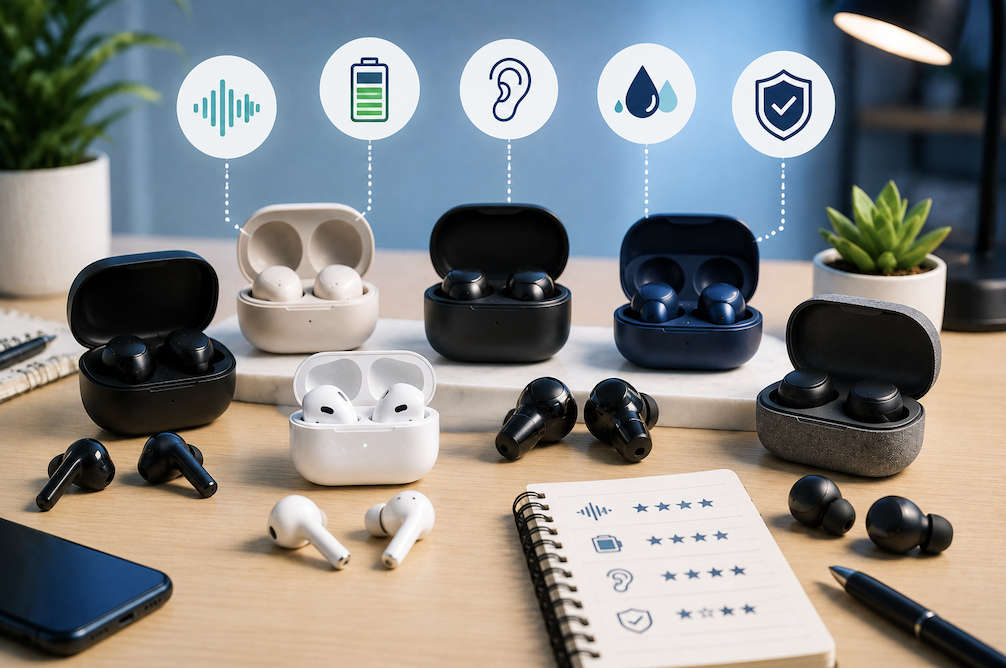
The under-$100 wireless earbuds market is crowded, and most of the differences between models come down to a handful of features that genuinely affect daily use. Rather than chasing a specific brand name, it’s more useful to know which features matter at this price point and which ones are mostly marketing. Here’s what to actually look for.
Sound Quality: What to Realistically Expect
At this price point, sound quality has become genuinely solid across most reputable brands, the days of budget earbuds sounding noticeably worse than premium ones are largely behind us for casual listening. The bigger differentiator now is tuning: some earbuds are tuned for bass-heavy listening, others for a flatter, more balanced sound. If a retailer or review source allows you to test before buying, listen to music you’re familiar with rather than an unfamiliar demo track, since you’ll notice tuning differences more easily in something you already know well.
Battery Life: Look at Total, Not Just Per-Charge
Two numbers matter here: how long the earbuds last on a single charge, and how many additional charges the case provides before it needs to be plugged in itself. A pair with 5-6 hours per charge and a case that provides 3-4 additional charges (roughly 20+ total hours) is a reasonable standard at this price point. If you frequently forget to charge devices overnight, prioritizing total case capacity matters more than per-charge duration.
Fit and Comfort Matter More Than Spec Sheets Suggest
Earbuds that don’t fit well undermine sound quality regardless of their actual audio hardware, since a poor seal in the ear canal affects bass response and can let in ambient noise. Multiple ear tip sizes included in the box are a meaningful feature, not a minor detail, ear canal size varies significantly between people, and the default medium tip doesn’t fit everyone well.
Connectivity and Codec Support
Bluetooth 5.0 or newer is a reasonable baseline at this price point, offering stable connections and reasonable battery efficiency. If you primarily use a specific phone ecosystem, check whether the earbuds support that platform’s preferred audio codec, mismatched codec support won’t prevent the earbuds from working, but it can mean slightly worse audio quality or connection stability than advertised.
Water and Sweat Resistance
For anyone using earbuds during workouts, an IPX4 rating or higher (resistant to splashes and sweat) is worth prioritizing. This has become common even at the budget tier, so it’s reasonable to treat it as a baseline requirement rather than a premium feature, particularly if the earbuds will see any regular exercise use.
Microphone Quality for Calls
This is one of the more overlooked specs, and one of the more noticeable ones in daily use if it’s poor. Earbuds marketed primarily around music listening sometimes deprioritize call quality, so if you’ll be using them frequently for phone or video calls, it’s worth specifically checking reviews that mention call clarity rather than assuming general sound quality reviews cover it.
Active Noise Cancellation: Worth It at This Price?
Active noise cancellation (ANC) has become available even in budget earbuds, but the quality varies significantly more than at the premium tier. Budget ANC is generally effective against low, consistent background noise (like an airplane engine or air conditioning) but less effective against sudden or varied noise (like conversation or traffic). If ANC quality is a priority, this is one area where reading recent, detailed reviews matters more than trusting the spec sheet alone.
Touch Controls vs Physical Buttons
This comes down to personal preference more than objective quality. Touch controls feel more modern but can trigger accidental taps when adjusting fit; physical buttons are more reliable but require pressing the earbud further into your ear, which some people find uncomfortable. Neither is objectively better, it’s worth considering which you’d find more annoying day to day.
Features That Matter Less Than They Sound
Wireless charging case support is convenient but rarely essential, most people are fine charging the case with a standard cable. Similarly, extremely high marketed driver sizes don’t directly translate to better sound; tuning and build quality matter more than the raw spec number.
Comparing Total Cost of Ownership, Not Just Sticker Price
Two pairs of earbuds priced identically can have very different long-term value once battery lifespan and replacement tip availability are factored in. Rechargeable batteries in wireless earbuds typically degrade over one to two years of regular use, and since most models don’t allow battery replacement, a pair with a strong reputation for battery longevity in long-term reviews often represents better value than a slightly cheaper pair known for shorter lifespan, even if the upfront price is a little higher.
Reading Reviews Effectively
When researching options, prioritize reviews that mention weeks or months of use over first-impression reviews written immediately after unboxing, since issues like battery degradation, ear tip wear, or connection reliability typically only surface after extended daily use. A pair that sounds excellent in a five-minute demo can still disappoint after a few months if build quality or battery longevity wasn’t part of the original review.
In-Ear vs Semi-Open Designs
Standard in-ear designs, which use silicone tips that seal the ear canal, generally offer better bass response and more effective passive noise isolation than semi-open designs, which sit in the outer ear without sealing the canal. Semi-open designs are often more comfortable for extended wear and allow more awareness of surrounding sound, which some people prefer for safety during outdoor activity, but they trade away some audio quality and noise isolation to do it. Neither is strictly better, the right choice depends on whether you’re prioritizing sound isolation or situational awareness.
Understanding Marketing Claims vs Real Performance
Marketing terms like “studio-quality sound” or “immersive bass” aren’t standardized and don’t correspond to any measurable specification, so they’re not useful for comparison between products. Specific, measurable details, driver size, frequency response range, actual battery hours, IP rating, are far more reliable indicators of real-world performance than descriptive marketing language on the packaging.
Multi-Device Pairing
Many earbuds at this price point now support pairing with two devices simultaneously (for example, a laptop and a phone), automatically switching audio between them. If you regularly move between devices throughout the day, this feature saves the repeated hassle of manually reconnecting each time and is worth checking for specifically, since it’s not yet universal even among otherwise similar models.
Case Design and Portability
The charging case is easy to overlook but affects daily use more than expected. A case that’s overly bulky is less likely to be carried consistently, while a case with a loose or unreliable lid can lead to earbuds falling out in a bag. Cases with a visible battery indicator (either an LED or an app readout) are more convenient than ones that require guessing whether a charge is needed.
How to Actually Test Before Committing
If buying in person, ask about the return policy before opening the packaging, since many retailers have shorter return windows for opened earphones due to hygiene policies. If buying online, check the specific return policy for opened electronics rather than assuming a standard return window applies, some retailers treat earbuds differently from other electronics for this reason.
Warranty Considerations
A one-year warranty is a reasonable standard at this price point. Register the product after purchase if the manufacturer offers that option, and keep the original receipt, since battery degradation (reduced playback time after months of use) is one of the more common warranty claims for wireless earbuds and isn’t always obvious without documentation of the original purchase date.
Battery Care Habits That Extend Lifespan
Leaving earbuds fully depleted for long stretches, or leaving them constantly on the charger far beyond a full charge, both contribute to faster long-term battery wear. Storing them at a partial charge if they’ll sit unused for weeks, rather than fully drained, is a small habit that meaningfully extends how long the battery holds a useful charge over the product’s lifetime.
Conclusion
At the under-$100 price point, prioritize fit (multiple ear tip sizes), realistic total battery life including the case, and call-quality reviews if you’ll use them for calls. Sound quality across reputable brands at this price has become fairly consistent, so the features above are what actually separate a good daily-use pair from one you’ll stop reaching for after a few weeks.
- Read more about Technewweb!