In the world of 2026, Bitcoin has evolved from a niche digital experiment into a global financial asset often called “Digital Gold.” But unlike physical gold, which is pulled from the earth using heavy machinery, Bitcoin is “mined” using powerful computers and complex mathematics.
If you have ever wondered how bitcoin mining works, you are not alone. To the average person, it sounds like magic: you turn on a computer, and digital money appears. In reality, it is a highly secure, competitive, and essential process that keeps the entire Bitcoin network alive. In this guide, we will peel back the curtain and explain Bitcoin mining in plain English.
1. What is Bitcoin Mining?
At its core, Bitcoin mining serves two main purposes:
- Creating New Coins: It is the only way new Bitcoins are entered into circulation.
- Verifying Transactions: It acts as a decentralized “accounting department” that ensures every transaction is legitimate and prevents “double-spending” (spending the same Bitcoin twice).
Instead of a central bank printing money, the Bitcoin network relies on a global community of “miners” to do the work.
2. The Step by Step Process: How it Happens
To understand what is bitcoin mining, you have to look at the journey of a single transaction.
Step A: The Waiting Room (Mempool)
When you send Bitcoin to a friend, that transaction goes into a digital waiting room called the “Mempool.” There are thousands of transactions waiting there at any given moment.
Step B: Grouping into a “Block”
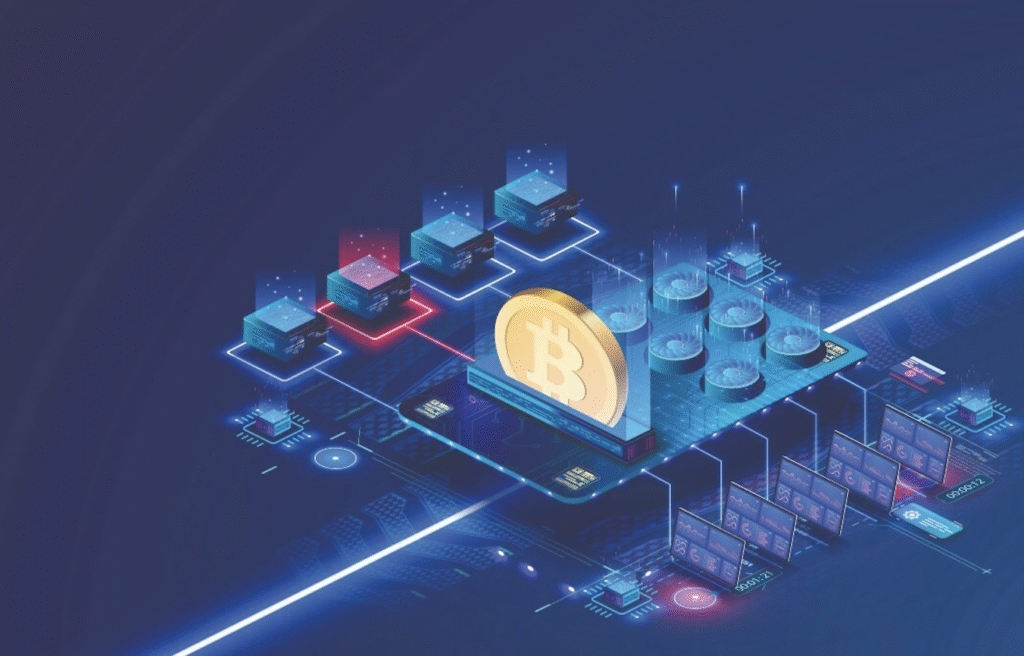
Miners take a group of these waiting transactions and bundle them together into a “Block.” Each block is like a single page in a giant, never-ending ledger (the Blockchain).
Step C: Solving the Puzzle (Proof of Work)
This is where the actual “mining” happens. To add their block to the official blockchain, miners must solve a cryptographic puzzle. This puzzle is so hard that no human could do it; even the most powerful computers must make trillions of guesses per second to find the answer.
3. The “Puzzle” Explained: Hashing and Nonces
The puzzle isn’t a math problem like $2 + 2$. It is more like a digital lottery.
- The Hash: Every block has a unique digital “fingerprint” called a hash. Bitcoin uses the SHA-256 algorithm. If even one comma is changed in a transaction, the entire hash changes completely.
- The Target: The network sets a “target” value. Miners must find a hash that is lower than this target.
- The Nonce: To change the hash, miners add a random number called a “Nonce.” They keep changing the Nonce and re-hashing the data until they get a “winning” number.
The first miner to find the winning hash shouts it out to the network. Other miners quickly verify it, and if it’s correct, the block is added to the chain.
4. The Reward: Why Do People Mine?
Mining is expensive—it requires specialized hardware and a lot of electricity. So, why do people do it?
- The Block Subsidy: In 2026, the reward for successfully mining a block is 3.125 BTC. At current market prices, this is a significant sum of money.
- Transaction Fees: Every person sending Bitcoin pays a small fee. The miner who wins the block collects all the fees from the transactions included in that block.
5. Bitcoin Mining Hardware in 2026
In the early days (2009), you could mine Bitcoin on a regular home laptop. Today, that is impossible. The competition is so high that you need specialized machines called ASICs (Application-Specific Integrated Circuits).
| Hardware Type | Efficiency | Usage in 2026 |
| CPU (Laptop) | Extremely Low | Obsolete (Will never find a block) |
| GPU (Gaming PC) | Low | Used for other coins, not Bitcoin |
| ASIC (Pro Miner) | Extremely High | Industry Standard (The only way to mine BTC) |
6. The “Halving” and Difficulty Adjustments
Bitcoin has two built-in features that make it unique compared to traditional money:
- The Halving: Every four years (or 210,000 blocks), the reward for miners is cut in half. This ensures that there will only ever be 21 million Bitcoins in existence, making it “deflationary.”
- Difficulty Adjustment: Every two weeks, the network looks at how fast blocks are being found. If miners are too fast, the puzzle gets harder. If they are too slow, it gets easier. This ensures a new block is found roughly every 10 minutes.
7. Sustainability: Is Mining Bad for the Environment?
A common concern is the electricity used in how bitcoin mining works. In 2026, the industry has shifted significantly toward green energy.
- Renewable Energy: Over 60% of Bitcoin mining is now powered by wind, solar, and hydroelectric power.
- Wasted Energy: Many miners set up near oil fields to use “flared gas” (natural gas that would otherwise be burned into the atmosphere) to power their rigs.
Conclusion
Bitcoin mining is the heartbeat of the cryptocurrency world. It is a brilliant combination of math, economics, and computer science that allows for a global, secure money system without a “boss” or a central bank.
While the days of mining at home for a profit are mostly gone, understanding how bitcoin mining works is essential for anyone who wants to navigate the future of finance. It is a competition of efficiency, where the prize is a piece of the most secure network ever created by humans.